If we do not remember a past life, what could possibly continue from one life to another?
At first, rebirth seems to require a permanent self—an unseen essence that travels from one body to the next. But Buddhism does not describe rebirth in this way. It does not depend on an eternal soul carrying memories across time.
Instead, it asks us to look more carefully at what we call a person.
Memory Is Not the Same as Continuity
We often assume that memory is proof of identity. If I remember yesterday, I feel that the person who experienced yesterday and the person living today are the same.
But memory is incomplete and constantly changing. We forget most of our experiences, yet we do not conclude that our life has ended each time a memory disappears.
A sleeping person may not remember the moment of falling asleep. A young child may not remember the earliest years of life. Still, there is a continuity of conditions connecting those moments.
Memory is one part of continuity, but it is not continuity itself.
A Flame Passing from One Lamp to Another
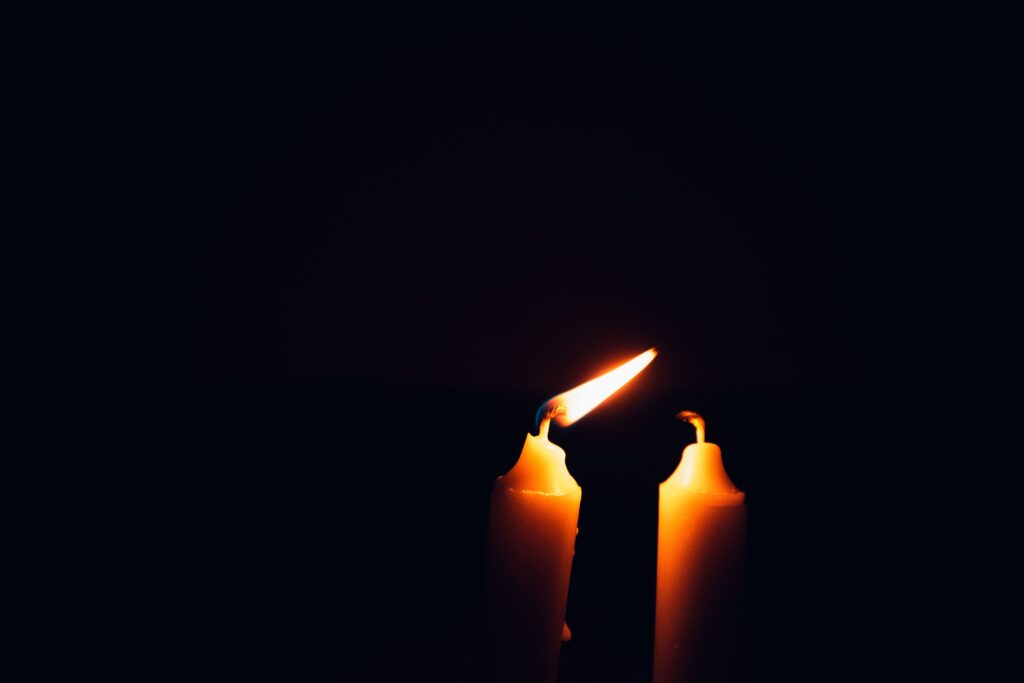
A traditional image compares rebirth to a flame being transferred from one lamp to another.
The second flame is not exactly the first flame. It is not entirely unrelated, either. The first flame provides the condition for the second to arise.
In the same way, one life is not carried into another by a permanent self. Rather, intentions, habits, attachments, and desires participate in a continuing process of cause and effect.
What continues is not a fixed identity.
What continues is the pattern of conditions.
The Influence of a Life Beyond Memory
Even within one lifetime, much of what shapes us operates beneath conscious memory.
A person may not remember when a fear began, yet the fear may still influence their choices. Someone may not recall learning a habit, yet the habit continues to guide their behavior.
The absence of memory does not mean the absence of influence.
From this perspective, rebirth does not require a person to remember a previous life. The important question is not, “Who is being carried forward?” but rather, “What conditions are still active?”
Craving can continue. Attachment can continue. The consequences of action can continue. These conditions may give rise to another form of experience, just as one moment conditions the next.
Neither the Same Person nor a Completely Different One
This view avoids two extremes.
The first is the idea that exactly the same person travels from life to life. That would require a permanent self, unchanged beneath all experience.
The second is the idea that each life is completely separate, with no connection at all. If that were true, actions and intentions would have no meaningful continuity.
The Buddhist understanding lies between these two positions.
The next life is not precisely the same as the previous one, but it does not arise independently of it. It is shaped by what came before, just as the person we become tomorrow is shaped by the choices and tendencies we cultivate today.
What This Means for the Present Life
This teaching is not only about what may happen after death. It also changes how we understand the present moment.
Every thought leaves a direction. Every repeated desire strengthens a tendency. Every act of grasping makes future grasping more likely.
In this sense, we are already creating continuity from moment to moment.
The person who wakes tomorrow will not be exactly the same person who goes to sleep tonight. Yet tonight’s thoughts, actions, and attachments will help shape tomorrow’s experience.
Rebirth can therefore be understood not as the movement of a soul, but as the continuation of a process.
What, Then, Can Come to an End?
If no permanent self is travelling through time, liberation does not mean destroying or releasing an eternal soul.
It means bringing the conditions of suffering to an end.
When craving and attachment are no longer being produced, the process that gives rise to further suffering loses its fuel. The question is not where the self will go, but whether the causes that keep the cycle turning are still being maintained.
We may not remember past lives because memory was never the foundation of continuity.
What continues is the chain of conditions.
And what can end is the compulsive movement of craving, attachment, and suffering.
The most important question is therefore not, “Who was I before?”
It is:
What am I continuing to create now?