Tag: mind

  • Brain vs Consciousness: What Buddhism and Neuroscience Still Cannot Fully Explain

    Brain vs Consciousness: What Buddhism and Neuroscience Still Cannot Fully Explain

    For centuries, human beings have tried to understand one of the deepest mysteries of all:

    Consciousness.

    Today, neuroscience studies consciousness through observation, measurement, and experiment.

    More than two thousand years ago, Buddhism approached the same mystery in a very different way.

    Not through machines.

    Not through laboratories.

    But through direct observation of the mind itself.

    At first glance, these two approaches seem completely different.

    Yet some of their conclusions are surprisingly close.

    Modern neuroscience increasingly suggests that the self is not a fixed entity.

    The brain is constantly changing.

    Thoughts change.

    Memories change.

    Emotions change.

    Even our sense of identity changes over time.

    What we call “self” appears less like a permanent thing and more like an ongoing process.

    This idea may sound familiar to students of Buddhism.

    The Buddha repeatedly questioned the existence of a permanent self.

    If the body changes,

    if feelings change,

    if thoughts change,

    what exactly remains unchanged?

    Both neuroscience and Buddhism point toward a similar observation:

    The mind is dynamic.

    Experience is constantly unfolding.

    And what we call identity may be far less solid than it appears.

    There is another fascinating overlap.

    Both recognize the power of habitual patterns.

    Neuroscience speaks of neural pathways.

    Buddhism speaks of conditioning, craving, and attachment.

    Different languages.

    Yet both suggest that repeated patterns shape the way we experience reality.

    But despite these similarities, a major difference remains.

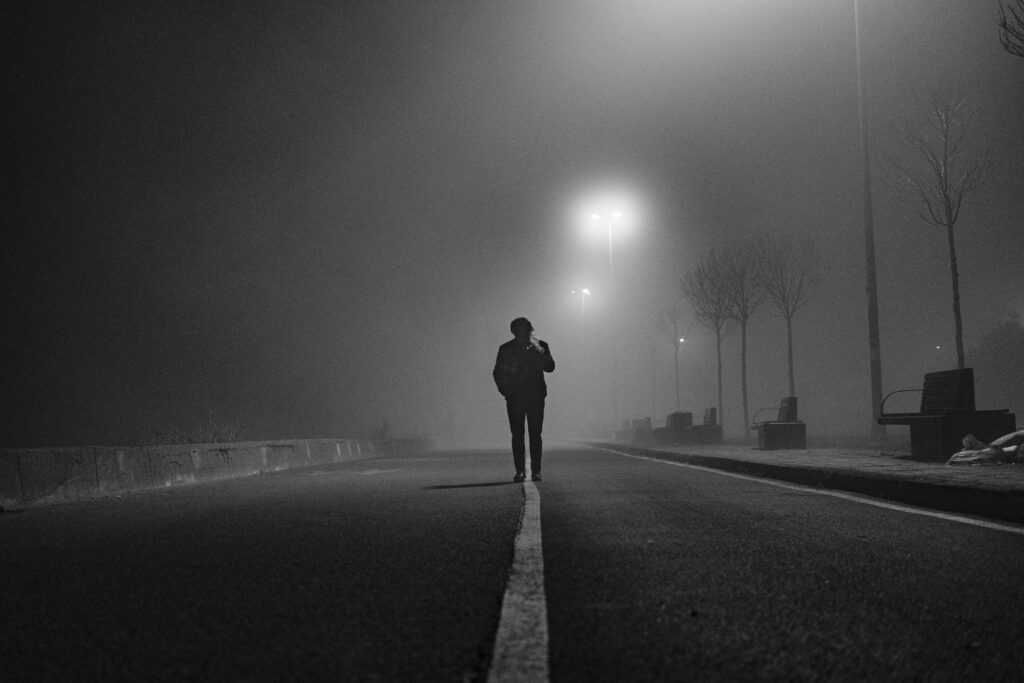
    A person quietly watching the night sky over the ocean, reflecting on the mystery of consciousness.

    Neuroscience generally assumes that consciousness depends upon the brain.

    When brain activity ends, consciousness ends.

    At least, that is the dominant scientific view today.

    Early Buddhism approaches the question differently.

    The Buddha did not clearly define consciousness as simply a product of the brain.

    Nor did he fully explain what happens after death.

    Instead, he left certain questions unanswered.

    Not because they were unimportant,

    but because he believed they did not lead directly to the end of suffering.

    As a result, the relationship between consciousness and the brain remains an open question in this conversation.

    And perhaps this is where both traditions become most interesting.

    Despite extraordinary advances in neuroscience, consciousness remains one of science’s greatest mysteries.

    How does subjective experience arise?

    Why does awareness exist at all?

    How does matter become experience?

    No one fully knows.

    The mystery remains.

    Perhaps Buddhism and neuroscience are not opponents.

    Perhaps they are exploring the same landscape from different directions.

    One studies consciousness from the outside.

    The other studies it from the inside.

    And maybe both perspectives still have something important to teach us.

    Because consciousness may be humanity’s most unfinished question.


    Watch the Video


    ← Back to Reflections Archive

  • What Remains Without Thinking?

    Person quietly watching the sunset

    Most of us spend our lives immersed in thought.

    Plans, memories, worries, opinions, judgments, and endless inner conversations fill the mind from morning until night.

    Because thinking is so constant, we rarely stop to ask a simple question:

    What remains when thinking becomes quiet?

    Occasionally, there are brief moments when thought slows down on its own.

    Perhaps while watching a sunset.

    Listening to music.

    Walking in nature.

    Or simply sitting quietly for a moment.

    There is no need to force it.

    The mind settles naturally, and a small gap begins to appear.

    Many people immediately try to fill that gap with another thought.

    Yet if we remain with it, something interesting can be noticed.

    The absence of thought does not feel like the absence of existence.

    We are still here.

    The world is still here.

    Sounds are heard.

    Colors are seen.

    Life continues.

    What disappears is not awareness itself, but the constant mental commentary about experience.

    This raises an important question.

    If awareness remains when thoughts become quiet, could awareness be more fundamental than thought?

    We often assume that thinking creates our sense of self.

    Yet direct observation suggests something different.

    Thoughts appear within awareness.

    Thoughts disappear within awareness.

    But awareness itself remains present throughout both.

    Open sky with slowly moving clouds

    Like clouds passing through the sky, thoughts come and go.

    The sky does not need to follow them.

    It simply remains open.

    In the same way, awareness does not need to hold onto every thought that appears.

    It quietly allows each one to come and go.

    Perhaps this is why moments of stillness can feel surprisingly peaceful.

    For a brief moment, there is nothing to defend, nothing to become, and nowhere to arrive.

    There is only simple presence.

    The next time thinking slows down, resist the urge to immediately search for the next thought.

    Pause.

    Notice what remains.

    You may discover that what you are is not created by thinking.

    And that beneath every thought, a quiet awareness has been here all along.

    Watch the Video

    This reflection is based on a video originally published on the Quiet Space YouTube channel.

    Watch the full video here:


    ← Back to Reflections Archive

  • You Are Not the Voice in Your Head

    Person standing quietly in contemplation

    There is a voice that seems to speak inside the mind.

    It comments on what we see, reacts to what happens, and constantly tells stories about who we are.

    Most of the time, we rarely question it.

    The voice feels familiar.

    It feels personal.

    It feels like “me.”

    But is it?

    If we observe carefully, something interesting begins to appear.

    The voice is never the same from one moment to the next.

    Sometimes it is calm.

    Sometimes anxious.

    Sometimes encouraging.

    Sometimes critical.

    Its opinions change. Its stories change. Its moods change.

    Yet we often assume that this constantly changing voice represents our true identity.

    This raises an important question:

    How can something so unstable be what we truly are?

    The inner voice is made of thoughts, and thoughts are not permanent.

    A memory appears.

    A worry follows.

    A plan begins to form.

    Thoughts arrive without invitation and disappear without asking permission.

    If we pay close attention, we may notice something even more surprising.

    We do not consciously create the next thought.

    Instead, we become aware of it after it appears.

    The voice may seem like one continuous stream, but it is actually made up of countless separate thoughts arising and fading moment by moment.

    Like clouds moving across the sky, thoughts appear connected, yet each one is temporary.

    And while thoughts constantly change, something else remains.

    Clouds drifting across an open sky

    There is an awareness that notices every thought.

    It observes without judgment.

    It does not argue.

    It does not need to defend itself.

    It simply knows.

    This awareness is not the voice.

    It is what hears the voice.

    When this distinction becomes clear, the inner dialogue begins to lose some of its authority.

    Thoughts are no longer commands that must be obeyed.

    They become events that can be observed.

    The voice is still there, but it no longer defines who we are.

    Perhaps the most important discovery is not learning how to silence the voice.

    Perhaps it is realizing that we were never the voice to begin with.

    We are the awareness in which the voice appears.

    And in that simple recognition, something quiet begins to open.

    Watch the Video

    This reflection is based on a video originally published on the Quiet Space YouTube channel.

    Watch the full video here:


    ← Back to Reflections Archive

  • Where Do Thoughts Come From?

    Have you ever noticed how a thought suddenly appears?

    Person quietly observing the sky and clouds

    One moment there is silence.

    The next moment, a memory, a worry, a plan, or an opinion arrives in the mind.

    Most of us spend our lives thinking without ever pausing to ask a simple question:

    Where did that thought come from?

    Did we consciously choose it?

    Or did it simply appear on its own?

    If we observe carefully, thoughts seem to arise much like clouds moving across an open sky.

    They appear.

    They change.

    They disappear.

    Yet something remains present throughout the entire process.

    There is an awareness that notices each thought as it comes and goes.

    This observation invites a deeper question.

    We often assume that we are the thinker.

    But can we actually find the moment when we decide what the next thought will be?

    Can we deliberately choose the very next thought before it appears?

    Or does the thought arrive first, with the sense of choosing coming afterward?

    These questions are not merely philosophical. They point toward direct experience.

    When we begin observing thoughts instead of immediately identifying with them, something subtle changes.

    Thoughts lose some of their authority.

    They become events occurring within awareness rather than commands that must be followed.

    A memory appears.

    A worry appears.

    A judgment appears.

    And each one can simply be noticed.

    Between thoughts there is often a brief gap.

    A quiet stillness.

    Still lake reflecting the sky

    Most of the time we overlook it because our attention is captured by the next thought.

    Yet that stillness may be just as important as the thoughts themselves.

    The next time a thought arises, try not to follow it immediately.

    Pause.

    Observe.

    Notice how it appears without invitation and eventually fades away.

    In that simple observation, the mind may begin to feel less solid than it once seemed.

    And perhaps we discover that what we truly are is not the movement of thought itself, but the awareness in which thought appears.

    Watch the Video

    This reflection is based on a video originally published on the Quiet Space YouTube channel.

    Watch the full video here:


    ← Back to Reflections Archive

  • The Buddha Refused to Explain the Afterlife — Here’s Why

    The Buddha Refused to Explain the Afterlife — Here’s Why

    The Buddha Refused to Explain the Afterlife — Here’s Why

    Many people assume that spiritual teachers have clear answers about what happens after death.

    Yet the Buddha often refused to answer questions about the afterlife.

    When asked whether the world is eternal or not, whether the self survives death, or what exactly happens after enlightenment, he frequently remained silent.

    Why?

    Was he hiding something?

    Did he not know?

    According to the early Buddhist texts, the reason was surprisingly practical.

    The Buddha believed that some questions do not lead to freedom from suffering.

    He compared them to a person struck by a poisoned arrow.

    Instead of removing the arrow, the person insists on knowing who shot it, what kind of bow was used, and where the arrow came from.

    Meanwhile, the poison continues to spread.

    In the same way, endless speculation about the afterlife can distract us from understanding the causes of suffering here and now.

    This does not mean the Buddha denied the possibility of rebirth or continued existence.

    Rather, he emphasized direct understanding over philosophical speculation.

    His teaching was not focused on constructing a theory of the universe.

    It was focused on awakening.

    Clouds floating in the sky representing the unknown nature of the afterlife

    The essential question was not:

    “What happens after death?”

    but

    “Can suffering end?”

    For the Buddha, the answer to that question mattered far more than any description of an unseen world.

    Reflection

    Perhaps the most important mystery is not what comes after death.

    Perhaps it is whether we are fully awake to this moment.


    Watch the Video


    ← Back to Reflections Archive

  • Who Is Aware of the Thought? Awareness, Mind and Consciousness

    A simple inquiry into the silent awareness behind thinking.

    We spend much of our lives immersed in thinking.

    Thoughts arise one after another—plans, memories, worries, hopes, judgments, and opinions.

    Most of the time we follow these thoughts without question.

    But occasionally a different question appears.

    A surprisingly simple one.

    Who is aware of the thought?

    When a thought arises, something notices it.

    You know that the thought is present.

    You know when it changes.

    You know when it disappears.

    But what is it that knows?

    Is it simply another thought observing the first one?

    Or is there something deeper that remains quietly present in the background of every experience?

    Before a word appears in the mind, before an opinion forms, before a judgment takes shape, there is already a simple awareness.

    It does not speak.

    It does not explain.

    It does not argue.

    Yet it is always here.

    Thoughts come and go continuously.

    A memory appears and fades.

    An emotion rises and passes away.

    A belief changes.

    A preference changes.

    Even the sense of who we think we are changes throughout life.

    But the simple fact of knowing experience remains.

    This awareness seems to be present before a thought appears.

    And it remains after the thought disappears.

    Can it be found as an object?

    Does it have a shape?

    A size?

    A color?

    A boundary?

    When we look carefully, awareness does not seem to possess any of these qualities.

    It is simply open.

    Present.

    Available.

    Without center and without edge.

    We often say,

    “I am thinking.”

    But is that completely true?

    Or is thinking simply something that appears within awareness, much like clouds appear in the sky?

    The clouds move.

    The sky remains.

    Thoughts move.

    Awareness remains.

    If you stop for a moment and make no effort to control the mind, something interesting may become apparent.

    Thoughts continue to come and go on their own.

    Yet there is still an awareness of them.

    That awareness is not created by thinking.

    It is not produced by effort.

    It is not something we manufacture.

    It is simply noticed when attention becomes quiet enough to recognize what has always been present.

    Perhaps the deepest inquiry is not where thoughts come from.

    Perhaps it is not even what thoughts mean.

    Perhaps the more fundamental question is:

    Who—or what—is aware of the thought?


    Related Video


    ← Back to Reflections Archive

  • Where Do Thoughts Come From? A Quiet Inquiry Into Awareness

    Every human being experiences thoughts.

    Memories appear unexpectedly.
    Plans for tomorrow arise on their own.
    A fear, an idea, or a random image can suddenly enter the mind.

    But have you ever paused to ask a simple question?

    Where do thoughts come from?

    Most of us are so occupied by the content of thinking that we rarely examine the process itself.

    Yet if we observe carefully, something interesting begins to reveal itself.


    The Moment Before a Thought Appears

    Before every thought, there is a brief moment of silence.

    A thought is not visible one second.

    Then suddenly it is there.

    It may be a memory from years ago.
    It may be a concern about the future.
    It may be a completely unexpected idea.

    The question is:

    Did you consciously choose that thought?

    Or did it simply appear?

    When examined closely, many thoughts seem to arrive on their own.


    Thoughts Move Like Clouds

    Thoughts often resemble clouds moving through an open sky.

    They appear.

    They change.

    They disappear.

    No thought remains forever.

    Yet something else remains present throughout the entire process.

    There is an awareness that notices each thought as it comes and goes.

    This awareness does not need to create the thought in order to observe it.

    It simply notices.


    Are We Really the Thinker?

    Most people assume:

    “I am the one who thinks.”

    But this assumption becomes interesting when we investigate it directly.

    Can you predict your next thought?

    Can you decide exactly what thought will arise ten seconds from now?

    Or does the next thought reveal itself before any conscious choice is made?

    This question has been explored not only in contemplative traditions but also in philosophy and modern cognitive science.


    The Space Between Thoughts

    When thoughts are observed without immediately following them, their nature begins to change.

    They lose some of their urgency.

    They become events occurring within awareness rather than instructions that must be obeyed.

    And occasionally something becomes noticeable.

    Between one thought and the next, there is a brief stillness.

    A silent space that has always been present.

    Most people overlook it because attention is constantly captured by the next thought.

    Yet this stillness may be more fundamental than the thoughts themselves.


    A Quiet Experiment

    The next time a thought appears, do not rush to follow it.

    Pause for a moment.

    Simply notice:

    • Where did this thought come from?
    • Did I choose it?
    • What was present before it appeared?

    No belief is required.

    Only observation.

    The answer may not be found through thinking.

    It may be discovered through awareness itself.


    Final Reflection

    Thoughts come and go.

    Memories come and go.

    Ideas come and go.

    Yet awareness remains.

    Perhaps the deepest question is not where thoughts come from, but what it is that quietly notices them.


    Watch the Full Video

    Watch the original Quiet Space video:


    ← Back to Reflections Archive