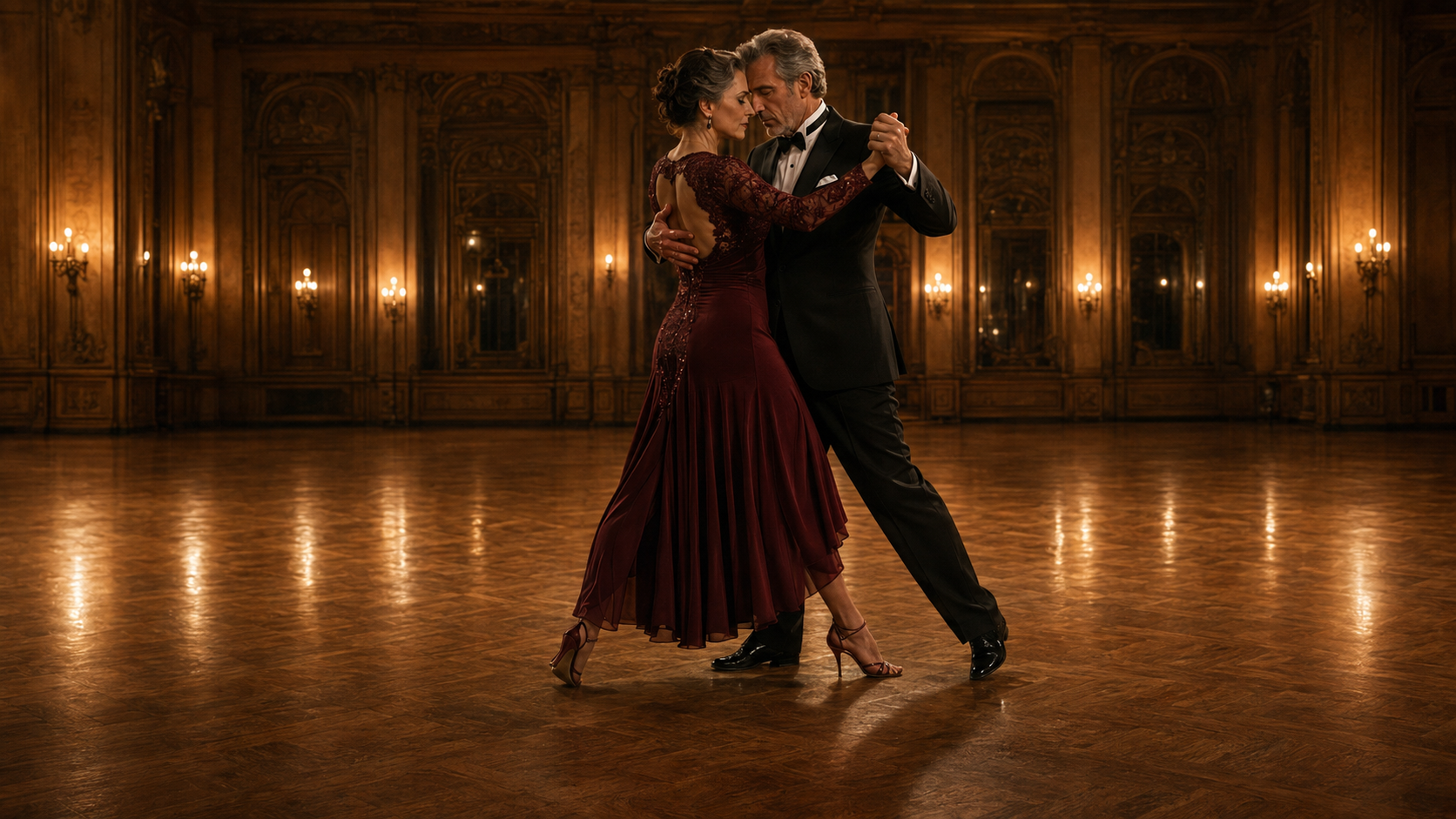
The history, character and musical language of Tango — with 38 orchestral ballroom pieces for an evening of dramatic elegance
Tango: A Dance That Begins with a Walk
People often describe Tango as a dance of passion. That is true, but it is only part of the story.
The real power of Tango does not come from exaggerated gestures. It comes from the tension between movement and stillness: one deliberate step, a suspended pause, a change of direction and the quiet awareness of another person’s weight and intention.
Before Tango became an international symbol of elegance and desire, it grew from the streets, social halls and working-class districts surrounding the Río de la Plata.
Born Between Buenos Aires and Montevideo
Tango cannot be understood as the creation of one person or one isolated community. It developed during the late nineteenth century in the urban environments of Buenos Aires, Argentina, and Montevideo, Uruguay.
These port cities brought together European immigrants, Afro-descendant communities, criollo traditions and people arriving from different social and cultural backgrounds. Their musical rhythms, instruments, customs and ways of moving gradually encountered one another and contributed to a new cultural expression.
UNESCO describes Tango as an Argentine and Uruguayan tradition that emerged among the urban lower classes of Buenos Aires and Montevideo. It was inscribed on the Representative List of the Intangible Cultural Heritage of Humanity in 2009. Read the UNESCO description of Tango.
This mixed origin is one reason Tango possesses such emotional complexity. Its character contains longing and pride, intimacy and distance, elegance and a lingering trace of melancholy.
From a Social Dance to an International Language
Tango began as a social experience rather than a polished theatrical spectacle. Its foundation was the encounter between two dancers responding to music and to each other.
As Tango travelled beyond the Río de la Plata, it entered theatres, cafés, recordings and ballrooms. Different communities adapted it, and distinct forms developed.
Today, “Tango” may refer to several related traditions. Argentine Tango remains closely associated with improvisation and social dancing, while Ballroom Tango has been shaped into a formal, standardized competitive discipline.
These forms share a common ancestry, but they should not be treated as identical.
Argentine Tango and Ballroom Tango
Argentine Tango is often built as an improvised conversation. The dancers may adjust the embrace, vary the length of their steps and respond spontaneously to changes in melody, rhythm and space. The path is not simply memorized in advance; it unfolds through attentive communication between the partners.
Ballroom Tango presents a more formal and standardized interpretation. It emphasizes a clearly defined frame, decisive movement, sharp changes of direction and disciplined partnership. The World DanceSport Federation classifies Tango as one of the five Standard dances, together with Waltz, Viennese Waltz, Slow Foxtrot and Quickstep. Standard dances are generally performed in a maintained closed position and hold. See the WDSF Standard dance classification.
One form is not more authentic or valuable than the other. Each developed for a different social and artistic setting:
- Argentine Tango values improvisation, intimate dialogue and individual interpretation.
- Ballroom Tango values formal structure, spatial clarity, dramatic line and technical consistency.
Understanding the distinction allows us to appreciate both traditions on their own terms.
What Makes Tango Look and Feel Different?
Tango is recognizable even before a complicated figure appears. Several fundamental qualities give it its unmistakable identity.
The Walk
At the heart of Tango is walking. A good Tango walk is never merely transportation across the floor. It carries intention, direction and awareness of the partner.
The Pause
Stillness is not empty time. A pause can heighten expectation, hold an emotion in suspension or prepare the next movement. Tango often becomes most expressive at the moment when the dancers appear to do almost nothing.
Connection
The partners must constantly read changes in balance, weight and direction. This connection allows movement to feel shared instead of mechanically synchronized.
Contrast
Tango thrives on contrasts: sharp and soft, near and distant, advancing and retreating, movement and restraint. Its drama is created through control rather than continuous display.
Direction
Sudden turns and changes of pathway give Tango its alert, watchful character. The dancers appear to make decisions within the music rather than simply travel through a predetermined sequence.
Listening to Tango
Tango is both music and dance, and its history reflects contributions from cultures and communities connected across several continents. The Library of Congress offers a concise introduction to Tango’s Argentine and Uruguayan origins.
When listening, try following more than the melody.
Notice the underlying walking pulse. Listen for phrases that seem to advance and then hesitate. Pay attention to the response between the melody and the lower instruments, and to the way a musical silence can feel as important as a sounded note.
The bandoneon became one of Tango’s most recognizable musical voices, but Tango can also be expressed through strings, piano, bass and larger orchestral arrangements. Each setting reveals a different shade of its character.
About This Tango Collection
Quiet Space Tango Collection presents 38 orchestral ballroom pieces across 1 hour, 24 minutes and 31 seconds.
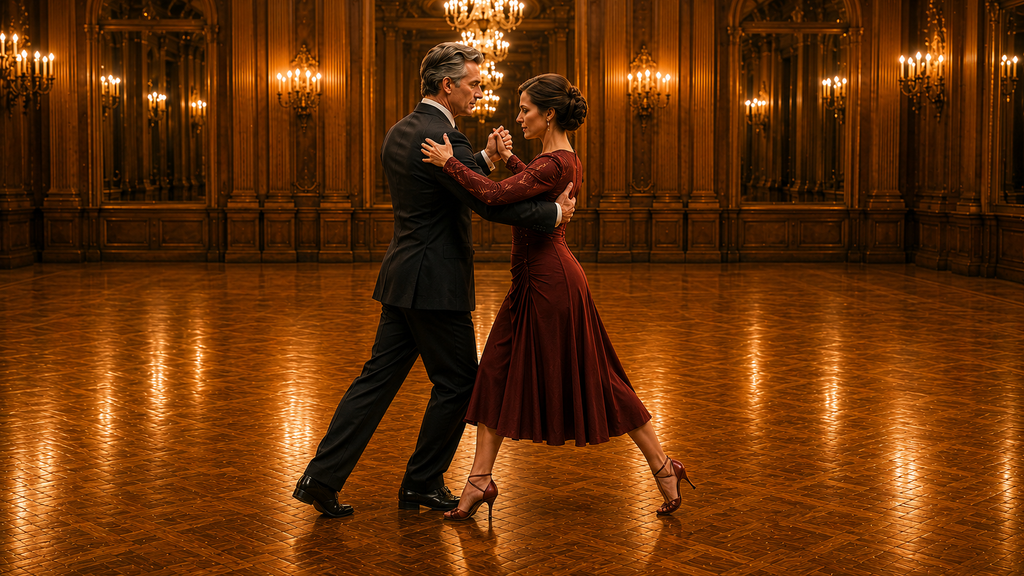
This is not intended as a reconstruction of an historical Tango orchestra or a documentary recording of a traditional social dance. It is a visual and musical interpretation of Tango’s dramatic atmosphere through contemporary orchestral music and ballroom imagery.
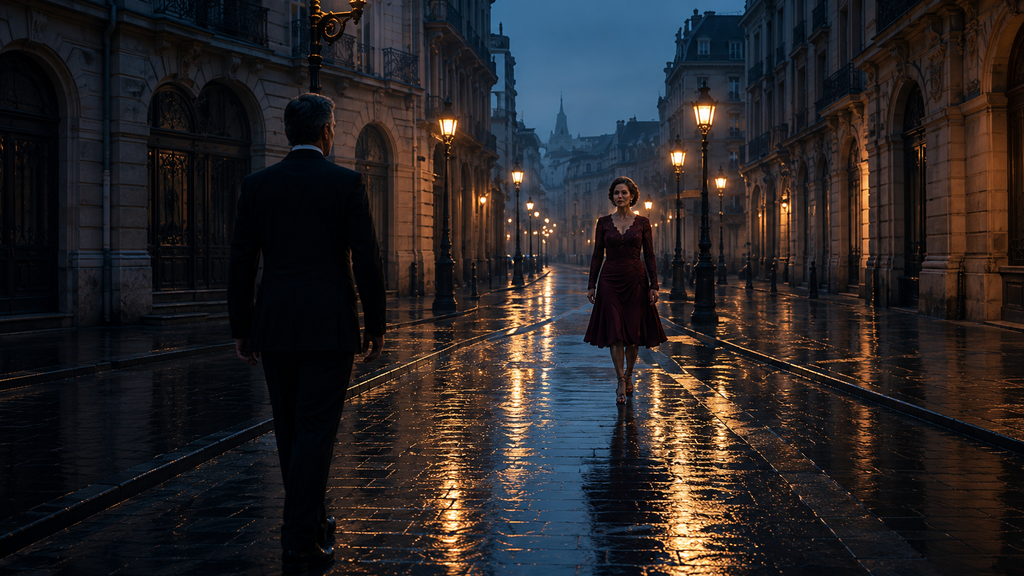
Across the collection, the mood moves through rain-darkened streets, chandeliers, distant footsteps, restrained encounters and moments of quiet release. The sequence has been arranged as one continuous ballroom evening rather than as a set of unrelated tracks.
A Simple Way to Experience the Collection
You do not need to know Tango technique to enjoy this music.
Begin by listening for the walking pulse. Let the pauses remain pauses. Notice when the music draws two imaginary figures together and when it leaves space between them.
Some tracks carry a sharper ballroom character. Others linger in a quieter, more reflective atmosphere. Together, they reveal that Tango is not only about dramatic movement—it is also about what remains unspoken.
Quiet Space Tango Collection
38 orchestral Tango-inspired ballroom pieces
Running time: 1:24:31
Whether you listen while reading, working, resting or simply watching the imagined ballroom unfold, we hope this collection offers a doorway into the enduring world of Tango.
Further Reading
- UNESCO — Tango as Intangible Cultural Heritage
- World DanceSport Federation — Standard and Latin Dances
- Library of Congress — Tango’s Cultural Background