
Rumba reveals how much a dance can say without haste. Explore its Cuban roots, its transformation into ballroom Rumba, and the music, control, and human connection that give this dance its quiet fire.
There are dances that cross a room with speed, and dances that command attention through stillness. Rumba belongs to the second kind. Its steps may appear measured, but beneath that restraint lies a continuous conversation—between rhythm and silence, control and release, invitation and response.
For many listeners, Rumba is first recognized by its romantic atmosphere. Yet romance alone does not explain its enduring appeal. The dance asks two people to listen closely: to the music, to weight, to timing, and to one another. Nothing needs to be rushed. A pause becomes part of the phrase, and a small shift of the body can carry the emotional weight of a much larger gesture.
From Cuban culture to the ballroom
The word “rumba” embraces more than one tradition. Cuban rumba developed from Afro-Cuban cultural life, bringing together percussion, song, movement, communal expression, and influences formed through Cuba’s complex history. UNESCO describes Cuban rumba as a practice associated with African heritage while also containing Antillean and Spanish elements, expressing resistance, self-esteem, grace, sensuality, and joy.
Ballroom Rumba is not identical to traditional Cuban rumba. During the twentieth century, dance teachers and competition organizations adapted Latin dance material for social and competitive ballrooms. The result became a slower, more codified partner dance. Today, International-style and American-style Rumba use different basic actions and timing conventions, but both rely on controlled weight transfer, leg action, musical awareness, and partnership.
Recognizing this distinction matters. The ballroom form has its own beauty and history, but its name still points back toward a much broader Cuban cultural world.
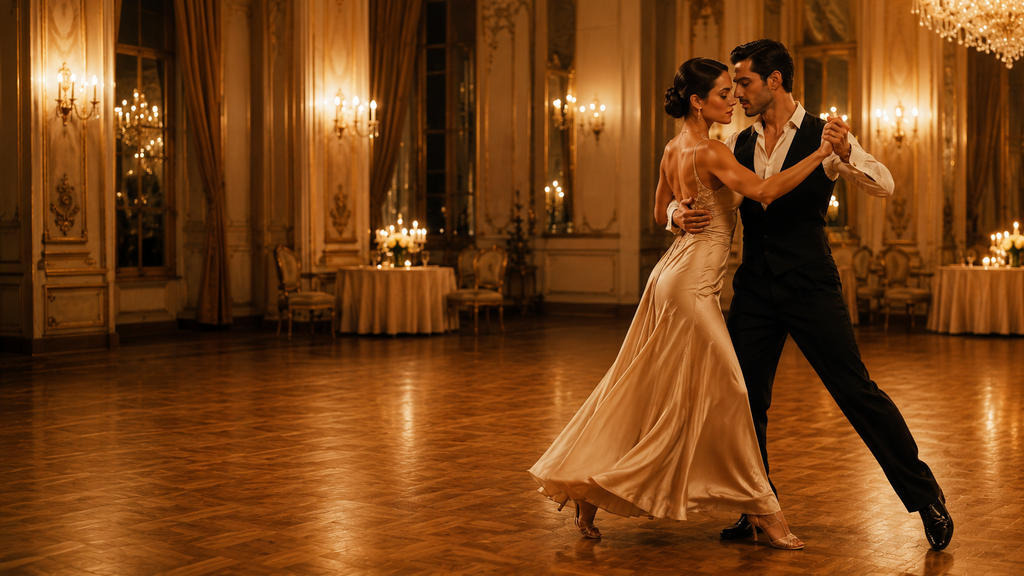
Why Rumba feels slower than it is
Slow music does not make Rumba easy. In fact, the space between beats exposes every decision. Balance cannot be hidden by speed. Each transfer of weight must be deliberate, and the dancer must remain connected to the floor while allowing the body to respond naturally to the step.
This is why accomplished Rumba can feel suspended in time. The dancers do not simply move on the beat; they shape the journey toward it. The audience sees preparation, arrival, and release. What looks effortless is usually the result of careful control.
A conversation rather than a display
Rumba is often described as a dance of love, but its emotional range is wider than a single romantic story. It can suggest hesitation, trust, longing, playfulness, reconciliation, or farewell. The partnership is most convincing when the dancers appear to respond rather than merely perform synchronized figures.
Eye line, distance, and timing become part of the choreography. At one moment the couple may move closer; at another, the space between them becomes the most expressive element on the floor. Connection does not always mean physical contact. Sometimes it is the shared awareness that remains even as two bodies move apart.
Listening to Rumba as orchestral music
Rumba can also be enjoyed without watching a dance. Warm strings can lengthen the melodic line, piano can add intimacy, and restrained brass or woodwinds can give the music color without disturbing its poise. Percussion provides a pulse, but the most memorable arrangements leave room for melody to breathe.
That balance guides this 36-track, 1-hour-33-minute collection. The program moves from the first invitation across the ballroom through candlelight, velvet shadows, chandeliers, and moonlit floors, before arriving at a final promise: “Until We Dance Again.” The titles form a quiet emotional arc, but listeners are free to create their own story.
This music may accompany ballroom practice, a calm evening, reading, dinner, or simply the wish to let a room become gentler for a while.
What to notice while watching
Rather than looking only for large figures, notice the smaller details:
- how a dancer settles weight before beginning the next action;
- how the couple uses distance to create tension and release;
- how stillness continues the musical phrase rather than interrupting it;
- how the upper body remains expressive without losing control;
- how the character of the dance changes as the orchestration changes.
Rumba reminds us that slowness is not emptiness. It is room—room to listen, to choose, and to make a single step meaningful.
Watch the full collection
Ballroom Rumba Collection presents 36 original orchestral tracks across 1 hour, 33 minutes, and 18 seconds.
📺Continue afterward with more elegant partner dances in the Ballroom Dance Memories series from Quiet Space Music.