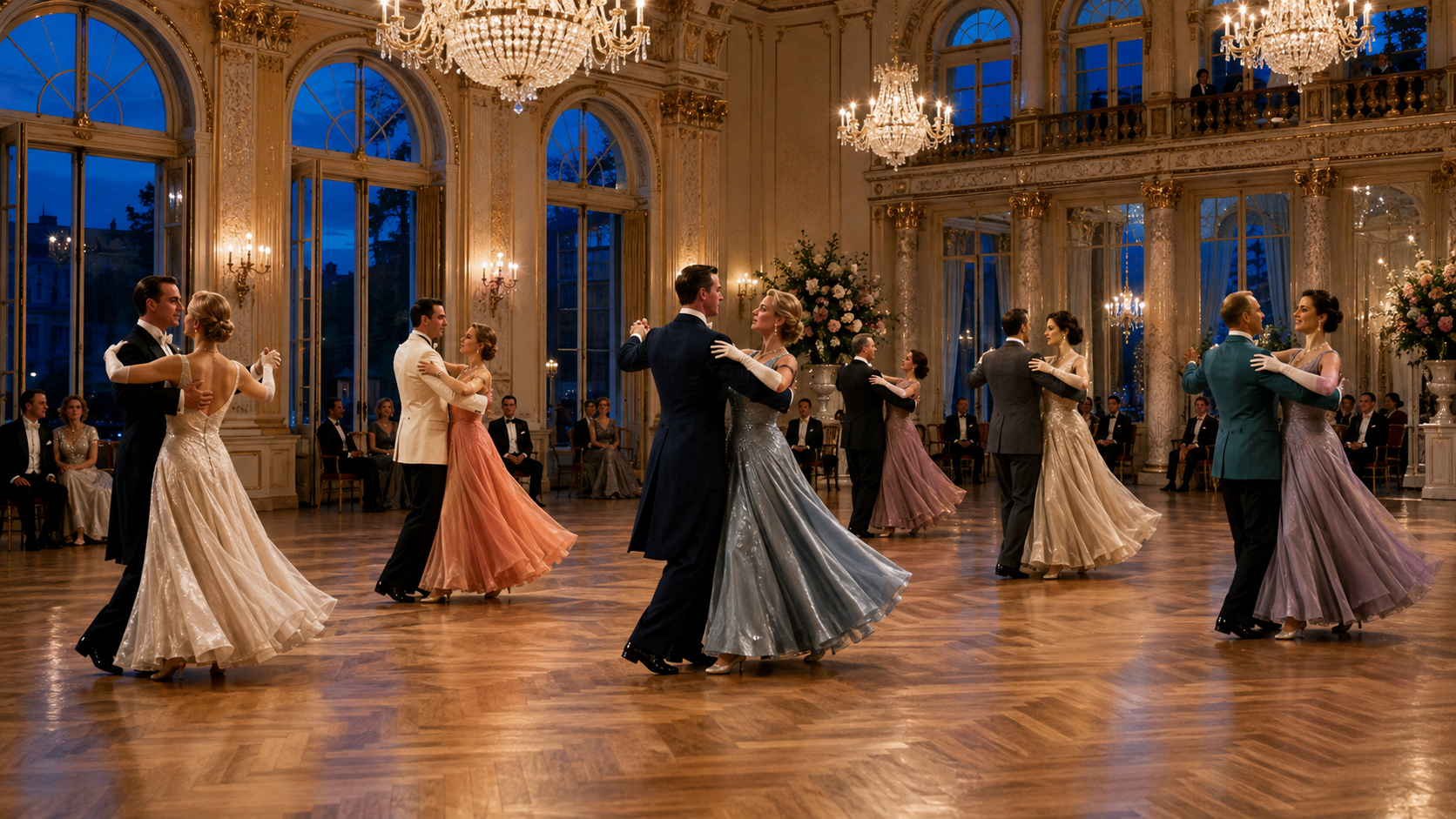
The Art of Slowness, Balance, and Grace
English Waltz is one of the most graceful forms of ballroom dance.
It moves through the room with a gentle three-beat rhythm, rising and falling like a calm breath. Its beauty does not depend on speed, spectacle, or dramatic gestures. Instead, it emerges from balance, connection, musical phrasing, and the quiet space between one step and the next.
Also known as Slow Waltz, English Waltz is danced at a much slower tempo than Viennese Waltz. This slower pace gives dancers time to shape each movement, extend each line, and allow the music to unfold fully.
It is a dance that does not hurry.
It invites the dancers—and those watching them—to remain inside the moment.
From Social Waltz to Ballroom Art
The history of Waltz began with social dances from Central Europe. During the eighteenth and nineteenth centuries, the three-quarter rhythm and rotating movement of the Waltz gradually entered European ballrooms and became one of the most influential developments in partner dancing.
The early Waltz was more closely associated with continuous turning and social dancing. As the dance evolved, slower forms began to emerge. These allowed couples to travel more extensively across the floor and to express the music through controlled rise and fall.
In England and within the International Style of ballroom dancing, this slower form developed into what is commonly called English Waltz or Slow Waltz.
The dance eventually became one of the principal Standard ballroom dances. Its importance comes not only from its popularity, but also from the technical foundation it provides: posture, balance, movement along the line of dance, rise and fall, sway, and communication between partners.
English Waltz transformed the Waltz from a sequence of turns into a spacious form of ballroom expression.
The Music of English Waltz
English Waltz is built on a three-quarter musical pattern.
The first beat usually provides the main point of emphasis, followed by two lighter beats. This creates the familiar feeling of:
ONE — two — three
But the musical character of English Waltz is more than a simple count.
Its slower tempo allows the melody to breathe. A phrase can begin quietly, expand gradually, and return to stillness without being rushed. The music often feels as if it is floating forward rather than being pushed forward.
In an orchestral arrangement, the strings often carry the emotional line. Their sustained sound supports the long, flowing movement of the dancers. Piano, harp, woodwinds, and soft percussion may add detail without disturbing the central calm of the music.
For this reason, a successful English Waltz arrangement should not feel hurried or mechanically rhythmic. The pulse needs to remain clear, but the melody must have room to move.
In this collection, the orchestra is not merely background music. It creates the atmosphere in which every step, turn, and pause can be felt.
How English Waltz Moves
English Waltz is a progressive dance. The couple generally travels around the ballroom along the line of dance, moving through space while maintaining connection and control.
One of its defining characteristics is the use of Rise and Fall.
The dancers do not remain at one level throughout the movement. They gently lower, rise, and settle again, creating a pendulum-like quality. This produces the impression that the couple is gliding across the floor rather than simply walking through a series of steps.
The movement also depends on:
- Smooth forward and backward travel
- Controlled turning
- Balanced posture
- Gentle sway
- Coordinated timing
- Continuous connection between partners
The most impressive moments are often not the largest ones. A small change in weight, a carefully timed turn, or a brief extension of the body can make the movement feel expansive when it is connected properly to the music.
English Waltz does not rush toward the next step. Each movement prepares the space for the movement that follows.
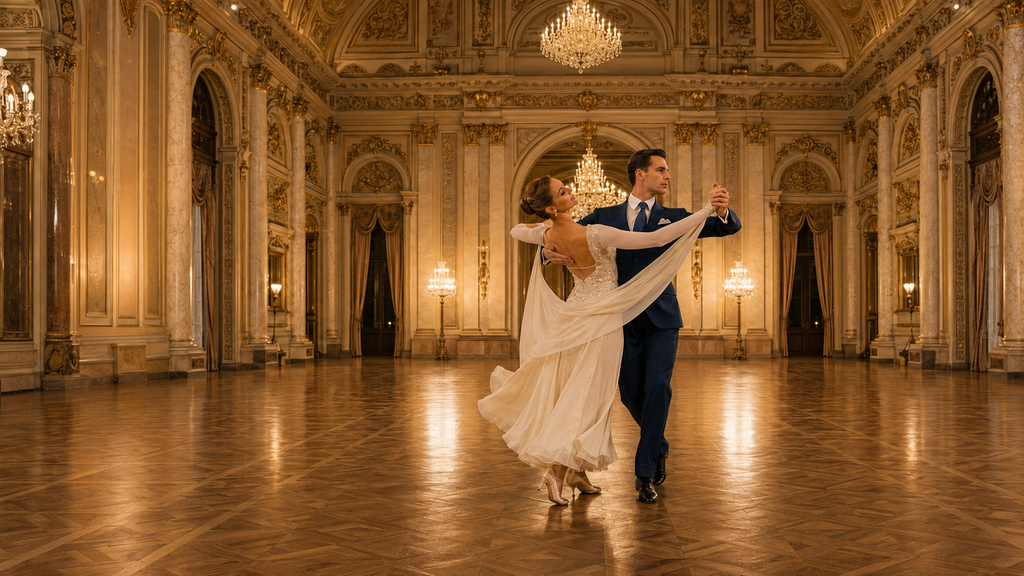
A Dance of Connection
English Waltz is danced by two people, but its visual impression comes from their ability to move as one coordinated unit.
The partners must remain aware of one another while also responding to the music and the direction of the dance. The leader initiates movement, while the follower receives and interprets that movement. The result should not look like one person giving orders and another simply following.
At its best, English Waltz resembles a conversation without words.
The couple shares weight, timing, direction, and breath. Their connection is visible not through exaggerated gestures, but through the ease with which one movement leads into another.
This is why English Waltz can feel intimate even when it is performed in a large ballroom.
The Emotional World of English Waltz
English Waltz is romantic, but its romance is restrained.
It does not require dramatic passion or theatrical display. Its emotional world is quieter: the warmth of chandelier light, the sound of strings across a polished floor, the memory of an evening that seems to continue long after the music has ended.
It may suggest:
- A quiet dance at the beginning of an evening
- A meeting beneath the chandeliers
- A memory returning through music
- Two people moving together without speaking
- The calm beauty of a room slowly turning around them
English Waltz is elegant without becoming distant, and romantic without becoming excessive.
Its deepest quality may be its ability to make slowness feel full rather than empty.
English Waltz and Viennese Waltz
Although both dances use three-quarter music, English Waltz and Viennese Waltz create very different experiences.
| Feature | English Waltz | Viennese Waltz |
|---|---|---|
| Tempo | Slow and spacious | Fast and energetic |
| Main impression | Flowing rise and fall | Continuous rotation |
| Movement | Progressive travel with shaped figures | Rapid turning and changes of direction |
| Musical feeling | Lyrical and extended | Bright and driving |
| Emotional character | Intimate, reflective, elegant | Festive, brilliant, and exhilarating |
International-style English Waltz is commonly danced at approximately 84–90 beats per minute, while Viennese Waltz is approximately twice as fast. English Waltz therefore gives dancers more time to shape the body, extend the phrase, and explore the emotional details of the music.
The two dances should not be viewed as competing versions of the same experience. Viennese Waltz expresses the excitement of turning, while English Waltz expresses the beauty of moving slowly through time.
How to Listen to This Collection
This collection can be enjoyed in several ways.
You may listen while dancing, allowing the steady three-beat rhythm to guide your movement. You may also listen without dancing, simply following the changes in melody, orchestration, and atmosphere from one track to the next.
The collection is designed as an extended orchestral ballroom experience. Each track offers a different emotional color, but all of them remain connected by a common sense of grace, measured movement, and quiet elegance.
Rather than treating the music as unrelated individual pieces, listen to the entire collection as a single evening in an imagined ballroom.
The room changes.
The light changes.
The melodies change.
But the gentle movement of the Waltz continues.
About This Collection
This English Waltz Collection brings together a series of original orchestral compositions inspired by the atmosphere of the classic ballroom.
The music is shaped by flowing strings, lyrical melodies, gentle three-beat rhythms, and carefully measured arrangements. Some tracks feel like the beginning of an evening, while others suggest moonlit floors, quiet conversations, or the final moments before the ballroom falls silent.
The collection is suitable for:
- Ballroom dancing
- Quiet listening
- Evening relaxation
- Reading or reflection
- Creating a graceful background atmosphere
Our aim is not simply to present a list of Waltz tracks.
It is to create the feeling of entering a ballroom where music, movement, light, and memory exist together.
Track List
00:00:00 Track 01 — Silken Steps at Dawn
00:01:13 Track 02 — Chandeliers in Bloom
00:03:26 Track 03 — A Turn Through Moonlight
00:05:28 Track 04 — Ivory Petals in Flight
00:07:46 Track 05 — The Gilded Promenade
00:09:30 Track 06 — Velvet Sway
00:10:58 Track 07 — Ribbons Across the Floor
00:13:20 Track 08 — Starlight on the Balustrade
00:16:19 Track 09 — Pearl-White Reverie
00:17:48 Track 10 — Sapphire Rise and Fall
00:20:06 Track 11 — Lanterns Above the Waltzing Floor
00:22:41 Track 12 — Whispers in Three
00:25:14 Track 13 — Rosewood and Silver
00:28:01 Track 14 — The Duchess Glides
00:30:06 Track 15 — Blue Satin Passage
00:32:19 Track 16 — Nocturne for the Grand Hall
00:34:53 Track 17 — Golden Sway of Evening
00:37:37 Track 18 — Steps Beneath the Frescoes
00:39:31 Track 19 — A Quiet Arc of Stars
00:41:51 Track 20 — Featherlight Turning
00:43:13 Track 21 — The Amber Gallery
00:45:37 Track 22 — Sway of the Silver Curtains
00:47:41 Track 23 — Moonlit Ascension
00:49:38 Track 24 — A Garden Beyond the Ballroom
00:51:11 Track 25 — Crystal Footsteps
00:53:35 Track 26 — Romance at the Marble Stair
00:55:53 Track 27 — Piano Lace and Candlelight
00:57:37 Track 28 — The Last Chandelier
01:00:29 Track 29 — Summer Rain on Versailles
01:02:28 Track 30 — Farewell in Ivory Light
A Quiet Form of Beauty
English Waltz is not a dance built on speed or spectacle.
Its beauty lies in the measured passage from one movement to the next: the rise, the fall, the turning breath, and the silent connection between two people moving together.
The music gives the dancers time.
The dancers give the music shape.
And the ballroom becomes more than a place in which a dance is performed. It becomes a space where elegance can be felt slowly.
Enjoy this collection as music, as movement, and as a quiet journey through the timeless atmosphere of the Waltz.
Continue the experience with the full English Waltz collection on YouTube.