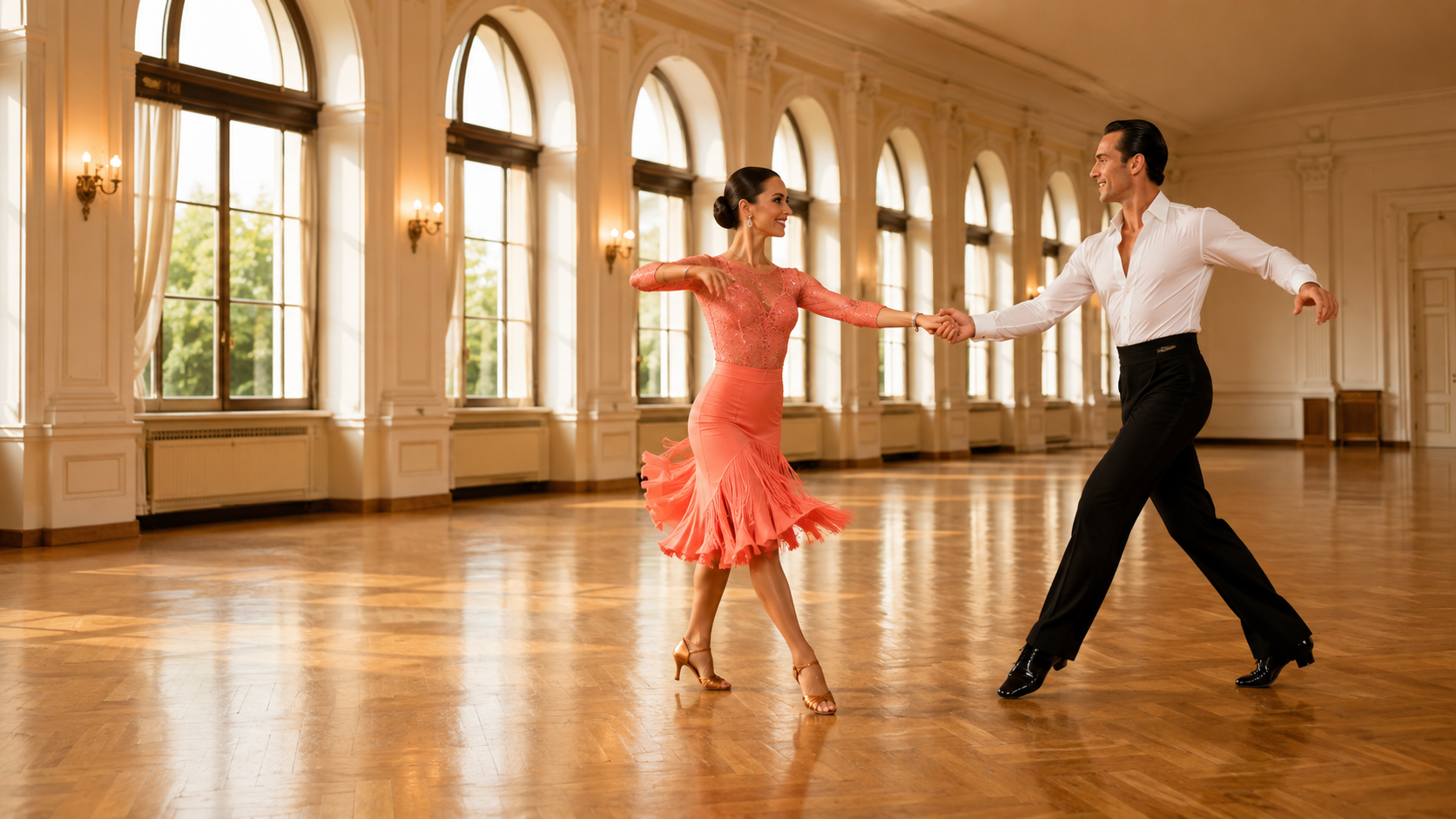
Cha Cha has a wonderfully conversational quality. A phrase seems to make a suggestion, a small change of direction answers it, and a quick rhythmic figure keeps the exchange moving. Listening with that image in mind can make the music engaging even when there is no dance floor nearby.
The dance offers a useful way into musical listening: notice the pulse, hear the smaller divisions within it, and consider how a change in emphasis might become movement.
From Cuban Dance Music to a Wider Audience
Cha Cha emerged from Cuba’s danzón–mambo tradition. Composer and violinist Enrique Jorrín, working with Orquesta América, is closely associated with its development. The name is commonly linked to the brushing sound of dancers’ feet. These roots place Cha Cha within a living exchange between musicians and social dancers. Smithsonian Folkways: The Cuban Danzón
The music became widely popular during the 1950s. Its subsequent international life is a reminder that a dance can travel while acquiring different teaching traditions and settings. Cuban social dance and today’s ballroom presentation belong to a connected history, but they should not be treated as interchangeable descriptions. Smithsonian Folkways teaching guide
Hearing the Rhythm: 2, 3, 4-and-1
A useful ballroom counting pattern is:
2 — 3 — 4 & 1
In a basic pattern, two weight changes on counts 2 and 3 are followed by a three-step chassé on 4-and-1. The last step arrives on the first beat of the following bar. The three steps therefore do not occupy three equally long beats: their timing is half a beat, half a beat, then one beat. WDSF syllabus
For a listening exercise, begin by tapping a steady four-count pulse. Then say “four-and-one” without speeding up the underlying beat. Notice how the subdivision briefly increases activity while the pulse continues unchanged.
That contrast can be heard as a small burst of conversation rather than a rush. It is also a helpful reason to listen beyond the main melody: the rhythmic detail may carry as much personality as the tune.
The Musical Colours Behind the Dance
Traditional charanga instrumentation associated with Cha Cha includes flute, strings, piano, bass and Cuban percussion such as timbales, tumbadora and güiro. This offers a broader sound world than the idea that Latin dance music must always be dominated by brass. Smithsonian Folkways album notes
One way to explore any arrangement is to listen in layers. Follow the bass for a phrase, shift attention to the percussion, and then return to the melody. Ask which layer establishes continuity and which creates surprise. The same passage can feel different each time attention moves.

Cha Cha in Ballroom Dance
Cha Cha is one of the five dances in the International Latin group, alongside Samba, Rumba, Paso Doble and Jive. Its ballroom vocabulary includes basic movements, turns and figures such as the New York and Hand to Hand. ISTD Latin American overview, ISTD syllabus
For the spectator, an inviting way to watch is to follow the exchange between partners: an approach, a change of direction, a response. For the listener, the equivalent is to hear a musical phrase as a question and the next as an answer. Neither exercise requires knowing every figure.
An Evening with Ballroom Dance Memories
This 36-track Cha Cha Orchestra Collection presents a listening programme lasting 1 hour, 5 minutes and 56 seconds.
Its poetic titles suggest an evening unfolding: the arrival of “Havana Opening Steps,” the exchange of “Ballroom Banter,” and the closing gesture of “A Bow to the Ballroom.” These titles provide an imaginative route through the programme; listeners can also set them aside and follow the music on its own terms.
Try listening once without interruption. On a second visit, choose three chapters and notice how your expectations change when you begin in a different place.
📺Watch the collection:
Explore Ballroom Dance Memories:
https://www.youtube.com/playlist?list=PLGWc184bksUg
Complete Track List
01. 00:00:00 — Havana Opening Steps
02. 00:02:17 — Brass and Bright Smiles
03. 00:04:26 — Golden Heel Rhythm
04. 00:05:51 — Playful Turn at Midnight
05. 00:07:53 — Chandelier Cha Cha
06. 00:09:41 — The Gentle Tease
07. 00:11:55 — Satin Steps in Sync
08. 00:13:48 — A Wink Across the Floor
09. 00:15:59 — Moonlit Cuban Spark
10. 00:18:12 — Champagne Tempo
11. 00:19:56 — Clever Steps for Two
12. 00:21:45 — Evening Rhythm Reborn
13. 00:23:02 — Elegant Cha Cha Entrance
14. 00:24:44 — Ivory Jacket, Golden Light
15. 00:26:17 — Ballroom Banter
16. 00:28:20 — Quick Glances, Soft Lights
17. 00:30:04 — Crystal Rhythm
18. 00:31:29 — A Playful Pause
19. 00:32:47 — Steps Beneath Chandeliers
20. 00:34:29 — Bright Floor, Light Hearts
21. 00:35:47 — Havana After Midnight
22. 00:37:41 — Polished Latin Glow
23. 00:39:23 — The Leader's Smile
24. 00:40:58 — Echoes in the Ballroom
25. 00:42:29 — Amber Rhythm
26. 00:44:06 — Midnight Footwork
27. 00:45:35 — A Turn of Charm
28. 00:47:34 — Silver Moon Cha Cha
29. 00:49:53 — Golden Conversation
30. 00:51:49 — Dancing Through the Applause
31. 00:52:56 — Last Set, Bright Steps
32. 00:55:04 — Velvet Night Rhythm
33. 00:56:32 — Poise After the Turn
34. 00:58:51 — One More Playful Step
35. 01:01:35 — Finale in Golden Light
36. 01:04:44 — A Bow to the Ballroom
A Different Way to Listen
The next time a short rhythmic figure catches your attention, let it become an imagined step. Then listen for what follows: a pause, a repetition, or an answering phrase.
Cha Cha offers room for that kind of attentive enjoyment. The dance floor may be elsewhere, but the conversation between rhythm and movement can begin wherever the music is playing.