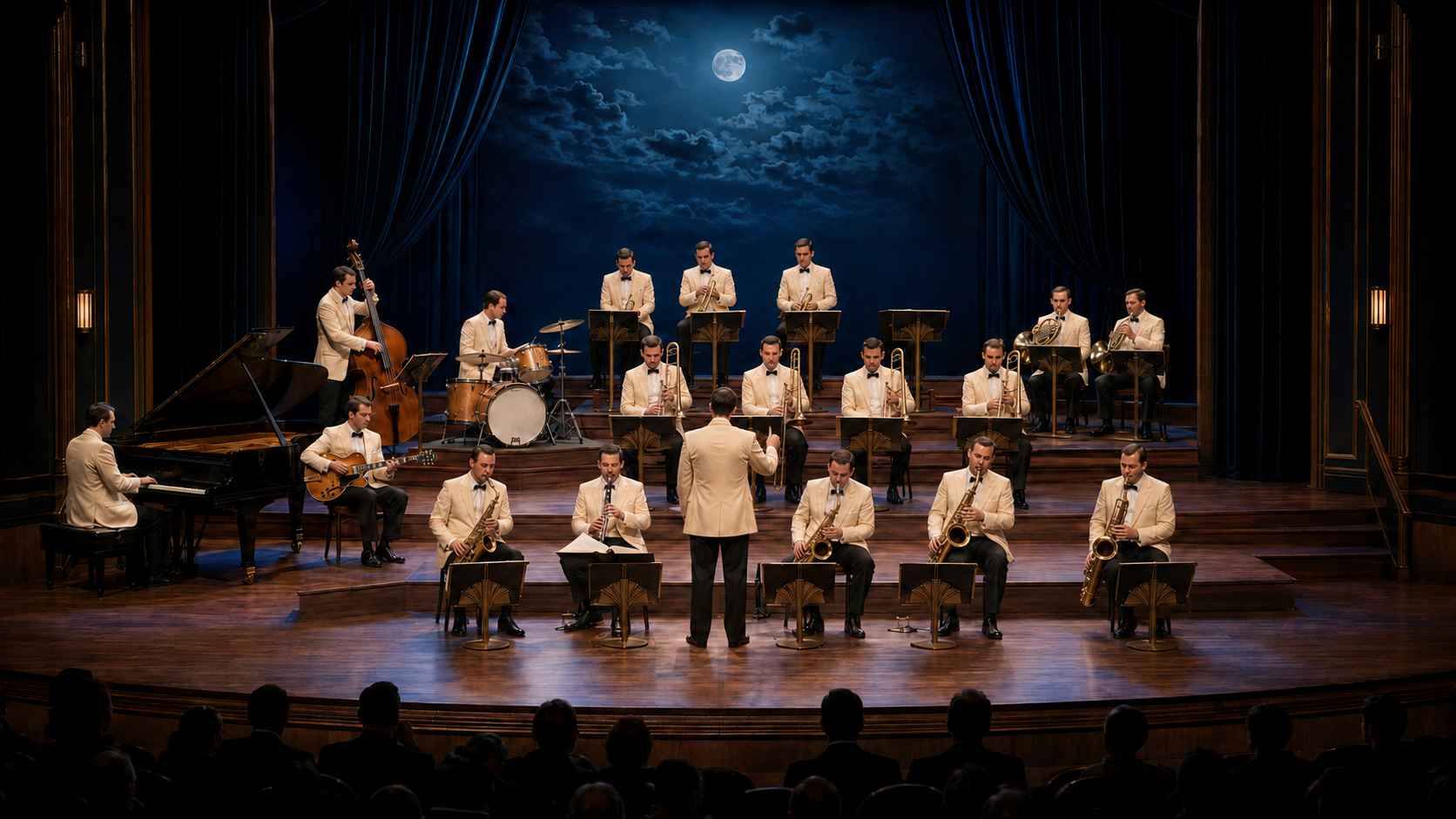
Glenn Miller gave the Swing Era one of its most immediately recognizable orchestral voices.
At a time when big bands filled ballrooms, theaters, radio studios, and hotel dance floors, his orchestra created a sound that was polished without becoming cold, disciplined without losing warmth, and danceable without sacrificing musical detail.
His career at the height of popular success was remarkably brief. Yet the music associated with his orchestra became part of the enduring memory of the twentieth century.
For generations of listeners, the opening bars of a Glenn Miller arrangement still evoke illuminated dance floors, late-night radio, wartime separation, reunion, romance, and hope.
The Sound
The Glenn Miller sound was built on clarity, balance, and an unmistakable blend of reeds.
Its best-known signature placed a clarinet above the saxophone section, while a tenor saxophone reinforced the melody below and the remaining reeds supplied closely blended harmony. The result was smooth, luminous, and immediately recognizable.
But that celebrated reed sonority was only one part of the orchestra.
Trumpets brought brilliance and lift. Trombones supplied warmth, weight, and rhythmic punctuation. Alto, tenor, and baritone saxophones gave the reed section contrasting colors rather than a single repeated tone. Piano, guitar, double bass, and drums maintained a firm but graceful swing pulse.
Miller’s arrangements depended on balance. Brass could become powerful without turning harsh. Reeds could sound romantic without losing rhythmic direction. Short musical phrases passed cleanly from one section to another, while carefully controlled dynamics made even the most energetic performances sound refined.
That combination—precision, warmth, and forward motion—allowed the orchestra to be equally persuasive in a quiet ballad and a crowded ballroom number.
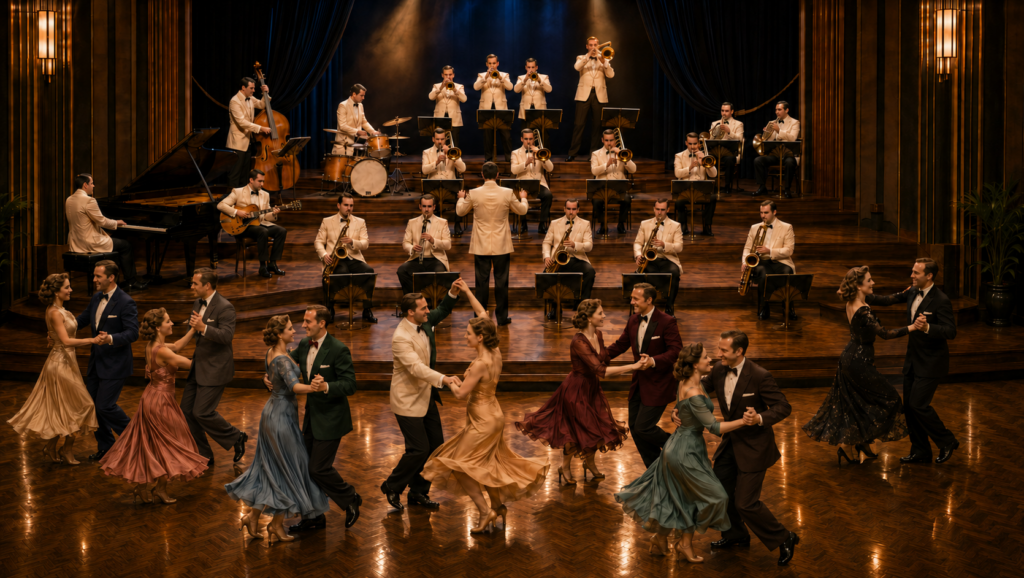
An imagined ballroom performance celebrating the elegance and rhythmic energy of the Swing Era.
The Concert Experience
A Glenn Miller performance belonged to the social life of its era.
This was music heard not only from a concert seat, but across polished dance floors, through home radios, in theaters, hotels, military halls, and public broadcasts. The audience did not merely observe the rhythm. Couples moved inside it.
In a number such as “In the Mood,” repeating riffs, exchanges between sections, and gradually building crescendos could transform the entire room into part of the arrangement.
In “Moonlight Serenade,” the same orchestra created an atmosphere of stillness, distance, and nocturnal romance.
The concerts balanced excitement with elegance. Fast swing numbers carried buoyant momentum, while ballads offered space to breathe. Individual solos emerged from within the ensemble and then returned naturally to the collective sound.
The band’s visual discipline—organized instrumental sections, coordinated phrasing, poised presentation, and carefully shaped dynamics—reinforced the confidence heard in the music.
It was entertainment of the highest craft: welcoming enough for dancers, distinctive enough for attentive listeners, and memorable enough to survive long after the ballroom lights were dimmed.
Music for the Ballroom
The Glenn Miller Orchestra understood that swing music lived through movement.
Its rhythm section established a steady foundation without overwhelming the melody. Brass figures added excitement, while the saxophones gave dancers a flowing musical line to follow. Even at brisk tempos, the arrangements maintained clarity and elegance.
This balance made the orchestra particularly effective in the great ballrooms of the Swing Era. The music could energize a crowded floor while remaining controlled enough for couples to dance comfortably.
The orchestra did not depend upon speed alone. Its vitality came from rhythmic placement, sectional contrast, anticipation, and release.
A quiet introduction could lead into a bright brass passage. A smooth reed melody could suddenly give way to a driving ensemble response. These changes kept the music alive while preserving its recognizable character.
For many listeners, Glenn Miller’s music became inseparable from the image of a ballroom filled with people sharing one rhythm.
The Wartime Orchestra
Glenn Miller’s story also belongs to the musical history of the Second World War.
In 1942, at the height of his civilian orchestra’s popularity, Miller entered military service and eventually led an Army Air Forces ensemble.
The military orchestra expanded the familiar big-band palette with a broader instrumental range. Swing rhythms, concert arrangements, strings, additional woodwinds, and colors such as French horns could coexist within one large organization.
This was not merely a civilian dance band wearing uniforms. Miller wanted to modernize military music while preserving the rhythmic vitality and accessibility that had made American popular music so widely loved.
Through performances and radio broadcasts, the orchestra carried familiar sounds to servicemen and listeners far from home. Its music offered entertainment, but it also provided morale, reassurance, and a living connection to ordinary life during an extraordinary period.
On December 15, 1944, Glenn Miller disappeared while flying from England toward France. He was never found.
The sudden ending of his life gave the music an enduring sense of absence. Yet his legacy was not defined only by that final journey. The vitality, romance, and confidence of the orchestra remain stronger than the silence that followed.
Legacy
Glenn Miller’s period of greatest fame lasted only a few years, yet the body of music associated with his orchestra became foundational to the memory of the Swing Era.
Recordings including “Moonlight Serenade,” “In the Mood,” “Tuxedo Junction,” “Pennsylvania 6-5000,” “A String of Pearls,” and “Chattanooga Choo Choo” continue to introduce new generations to a musical world in which melody, rhythm, arrangement, radio, and social dance were inseparable.
His influence can be heard in the way later arrangers treated the reed section as a unified orchestral color, in the precision expected of modern big bands, and in the enduring belief that popular orchestral music could be sophisticated without becoming distant.
The Glenn Miller Orchestra demonstrated that a signature sound does not require constant novelty.
It requires a clear musical identity, performers who understand one another, and arrangements in which every instrumental section has a purpose.
Decades later, that identity remains unmistakable.
A few notes from a clarinet and saxophone choir can still open the door to an entire era.
Discover the Inspiration
Some orchestras made people listen.
Some orchestras made people dance.
Glenn Miller made precision feel effortless.
His music joined the intimacy of a late-night serenade with the communal energy of a crowded ballroom.
A clarinet could float above the ensemble like a distant light. Moments later, brass and reeds could carry the entire room forward with irresistible swing.
That contrast inspires this Quiet Space tribute: moonlit calm and rhythmic lift, elegance and celebration, memory and motion.
The accompanying concert does not attempt to reproduce Glenn Miller’s recordings note for note. Instead, it presents newly created music reflecting broad qualities associated with the era—clear reed voicing, disciplined brass, graceful swing, romantic ballad writing, and the atmosphere of a great ballroom orchestra.
The concert also recognizes the variety within the classic big-band sound. Alto, tenor, and baritone saxophones contribute different registers and colors. Trumpets and trombones provide contrasting forms of brilliance and weight. Where appropriate, French horns add a broader orchestral color inspired by Miller’s wartime ensemble.
Every section has its own voice, but all of them move together.
Through Orchestra Memories, Quiet Space honors the spirit of an age when an orchestra could bring strangers together, turn a melody into a shared memory, and make one evening feel timeless.
About This Tribute
This page and its accompanying concert are independently created tributes presented as part of the Orchestra Memories series.
The music featured in the Quiet Space concert is newly created. It is not presented as an original Glenn Miller recording, a reconstruction of a particular historical performance, or a performance by the original Glenn Miller Orchestra.
The performers, conductor, audience, ballroom, and concert settings shown in the accompanying imagery are fictional. They represent an imagined third-party orchestra presenting a tribute to Glenn Miller’s musical legacy.
No historical photograph or visual reconstruction is intended.
Quiet Space Original Music
🎵 Quiet Space Original Music
Inspired by the luminous reed voicing, disciplined swing, romantic ballads, and ballroom energy associated with the Glenn Miller era.
▶ Listen on YouTube →